November 21st, 2025. Imogen Howells, Technical Director, Willowflow Group.
Artificial intelligence has quietly but rapidly made its way into the wider humanitarian and development ecosystem. What began as a tentative experiment in a few corners of the sector has now become part of daily practice for many practitioners. Still, how AI is used, discussed, or concealed varies widely.
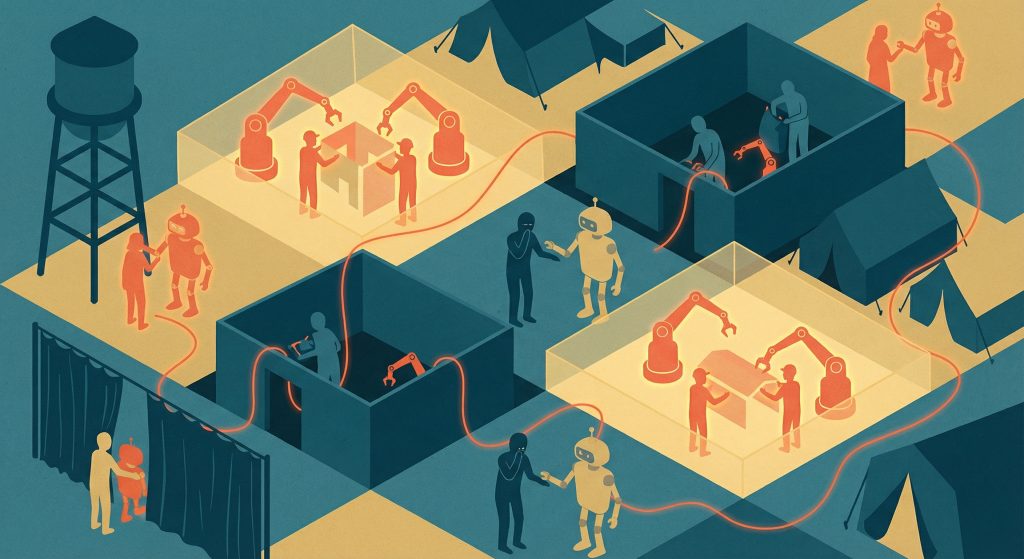
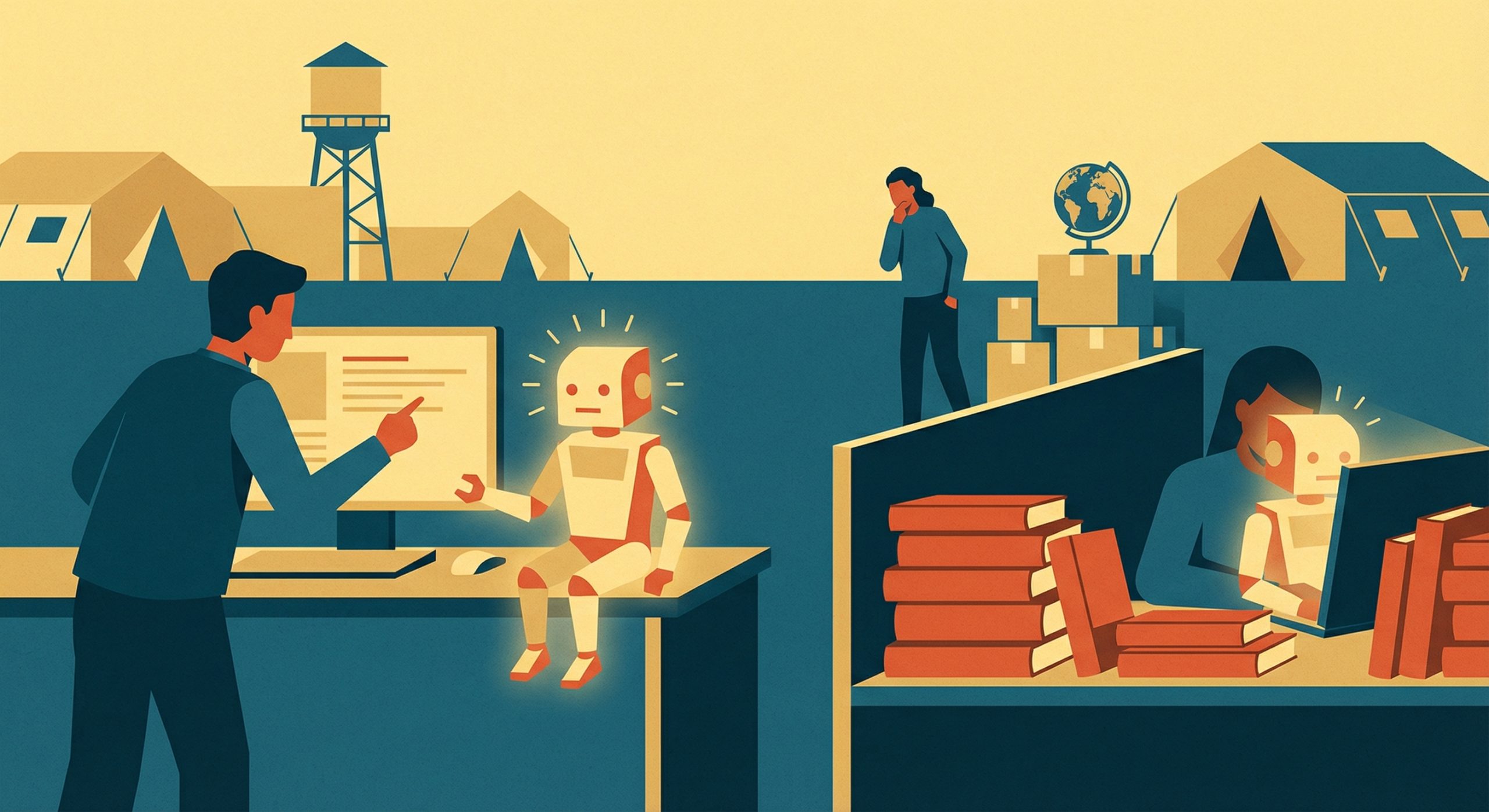
Not long ago, AI use often felt like a “dirty little secret” something people experimented with privately, without acknowledging it to colleagues or managers. Today, that pattern remains in some spaces but is far from universal. Many organisations now speak openly about AI, while others remain hesitant. The landscape is shifting faster than most governance structures can keep up with.
Quiet Adoption, Uneven Confidence
Across the global impact sector, practitioners have used AI tools to speed up desk research, summarise evaluations, generate initial drafts, or explore policy scenarios. For many, the appeal is simple: AI saves time in work environments that are chronically under-resourced.
Yet confidence varies. Some staff use AI openly, in teams where experimentation is encouraged. Others still proceed cautiously, editing outputs so they cannot be traced. These practices differ by organisation, geography, mandate, and risk appetite.
This diversity of approaches is understandable. For many organisations, internal policy has struggled to keep pace with technological change, in part because national governance frameworks only recently began to take shape. Without clear external benchmarks, organisations have developed internal guidance inconsistently, or not at all. The result is a patchwork of experimentation, caution, enthusiasm, and quiet avoidance.
Bans, Hesitations, and Complexity
Over the last two years, pockets of the sector have introduced partial or full restrictions on generative AI. These decisions were often driven by concerns about data protection, research integrity, discrimination risks, and reputational exposure. In some cases, bans were temporary, intended to buy time while national or institutional frameworks emerged.
These bans were never universal. Some organisations adopted highly permissive approaches, others leaned toward caution, and many fell somewhere in between. As national regulations develop, from data protection agencies, digital ministries, rights bodies, and technology regulators, many organisations are now revisiting earlier positions.
What we are observing is a sector still negotiating its relationship with AI, shaped by differing mandates, contexts, and risk environments.
Governance in Motion
Internal governance is evolving, but not evenly. Many teams still navigate questions such as:
- When and how should AI use be disclosed?
- What constitutes acceptable vs. higher-risk prompting?
- How do teams ensure human oversight remains central?
- Where does AI support efficiency and where does it pose ethical or operational risks?
These questions are not unique to humanitarian or development organisations. They echo across climate action, environmental protection, human rights advocacy, philanthropy, and responsible tech spaces.
As national frameworks mature, many organisations will likely move toward clearer internal guidance. But for now, as national and international governance structures are themselves only now emerging, variation is the norm.
Ethics and Practice
Ethical debates across the wider impact ecosystem remain active, and rightly so. Concerns about bias, power, representation, and community voice are still front and centre. What is emerging, however, is a recognition that ethical practice is not achieved through bans alone. It requires reasoned human intervention based on international rights standards.i
Different organisations draw the line differently. Some are exploring participatory approaches to AI evaluation. Others emphasise human review. Many are still deciding how to integrate AI into existing safeguarding, MEAL, research ethics, or editorial processes.
What seems clear is that ethical practice is evolving through dialogue and experimentation, rather than through certainty.
A Sector in Transition
AI is not a distant or abstract future; it is already part of everyday work in many corners of the aid and impact sector. But practice remains uneven, and the pace of change is challenging traditional governance structures. We are witnessing a moment of transition one where questions outweigh answers, and where organisations are learning in real time.
This think piece has offered reflections drawn from patterns we have observed across multiple parts of the sector. The intention is not to prescribe, but to hold space for an evolving conversation.
Full disclosure – this article was entirely generated by AI using prompts by Imogen Howells, Technical Director of Willowflow. One substantive edit noted below.